Module 4: Textiles, Jute and Tobacco
Concept
Subtopic 4.1: Textile Industry
- The textile industry has four branches: cotton, woollen, silk and artificial fibre.
- Cotton textiles are concentrated at Gaya and Phulwarisharif. Durries and carpets of Obra (Aurangabad) are exported.
- Small cotton mills are at Muzaffarpur, Munger, Bhagalpur, Kishanganj, Biharsharif and Madhubani. There are 40 hosiery factories, which get yarn from Kanpur and Ahmedabad.
- Bihar produces only tasar and endi (eri) silk. The silk industry grew around Bhagalpur, which mainly makes tasar fabrics.
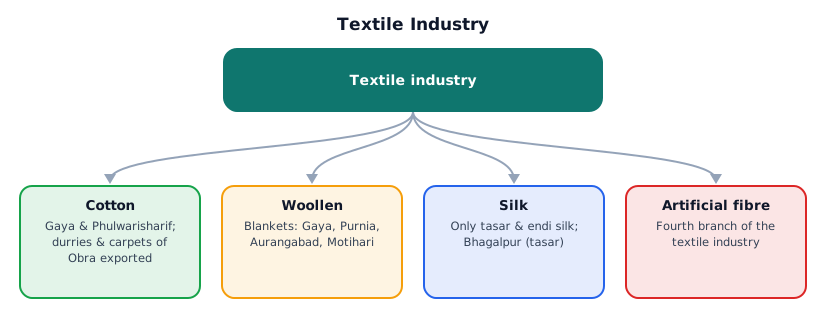
- Cotton textiles are concentrated at Gaya and Phulwarisharif.
- Obra's durries and carpets are exported.
- Only tasar and endi silk are produced; Bhagalpur mainly uses tasar.
- Yarn comes from Kanpur and Ahmedabad.
- Question: Bihar's cotton textile industry is concentrated at which places? Answer: Gaya and Phulwarisharif.
- Question: Durries and carpets from which place are exported abroad? Answer: Obra (Aurangabad).
- Question: Which kinds of silk are produced in Bihar? Answer: Only tasar and endi.
- Question: From where do Bihar's 40 hosiery factories get their yarn? Answer: Kanpur and Ahmedabad.
MCQs
Answer this question, then use Next.
Question 1: Bihar's cotton textile industry is concentrated at which places?
Question 2: Durries and carpets from which place are exported abroad?
Question 3: Which kinds of silk are produced in Bihar?
Question 4: From where do Bihar's 40 hosiery factories get their yarn?
One-liners
Write your answer, then submit to see the correct answer.
Bihar's cotton textile industry is concentrated at which places?
Gaya and Phulwarisharif.Durries and carpets from which place are exported abroad?
Obra (Aurangabad).Which kinds of silk are produced in Bihar?
Only tasar and endi.From where do Bihar's 40 hosiery factories get their yarn?
Kanpur and Ahmedabad.Concept
Subtopic 4.2: Jute Industry
- Jute is a leading foreign-exchange earning industry of India.
- Before independence India had 110 jute mills, mostly in West Bengal and Bihar, but 2/3 of the jute-growing area went to East Pakistan (Bangladesh).
- Purnia, Katihar, Saharsa and Darbhanga produce 8.3 lakh t of jute on 1.5 lakh ha; a jute mill has also been set up at Samastipur.
- Three big jute mills are at Purnia, Katihar and Darbhanga, notably the Rameshwar Jute Mills (Katihar) and Motilal Jute Mills (Darbhanga).
- Rameshwar Jute Mills is at Katihar; Motilal Jute Mills is at Darbhanga.
- There were 110 jute mills, mostly in West Bengal and Bihar.
- 8.3 lakh tonnes of jute come from 1.5 lakh ha.
- Two-thirds of the jute-growing area went to East Pakistan (Bangladesh).
- Question: Rameshwar Jute Mills is located at which place? Answer: Katihar.
- Question: How many jute mills did India have before independence? Answer: 110.
- Question: How much jute is produced on 1.5 lakh ha in Purnia, Katihar, Saharsa and Darbhanga? Answer: 8.3 lakh t.
- Question: After Partition, what share of the jute-growing area went to East Pakistan? Answer: 2/3.
MCQs
Answer this question, then use Next.
Question 1: Rameshwar Jute Mills is located at which place?
Question 2: How many jute mills did India have before independence?
Question 3: How much jute is produced on 1.5 lakh ha in Purnia, Katihar, Saharsa and Darbhanga?
Question 4: After Partition, what share of the jute-growing area went to East Pakistan?
One-liners
Write your answer, then submit to see the correct answer.
Rameshwar Jute Mills is located at which place?
Katihar.How many jute mills did India have before independence?
110.How much jute is produced on 1.5 lakh ha in Purnia, Katihar, Saharsa and Darbhanga?
8.3 lakh t.After Partition, what share of the jute-growing area went to East Pakistan?
2/3.Concept
Subtopic 4.3: Tobacco, Cigarette and Bidi Industry
- Purnia, Saharsa, Darbhanga and Munger are important in the tobacco industry; Munger, Patna and Gaya lead in bidi making.
- The Imperial Tobacco Company (now ITC) cigarette factory is at Dilawarpur, Munger.
- There are 250 small and large bidi units; bidi is also made at Jhajha, Lakhisarai, Jamui, Biharsharif, Manpur, Ara and Buxar.
- Notable bidi centres in North Bihar: Mahnar, Dalsinghsarai, Shahpur and Ayodhyaganj Bazar.
- The ITC cigarette factory is at Dilawarpur in Munger.
- There are 250 small and large bidi units.
- Mahnar, Dalsinghsarai, Shahpur and Ayodhyaganj Bazar are North Bihar's bidi centres.
- Munger, Patna and Gaya lead in bidi making.
- Question: Where is the ITC (formerly Imperial Tobacco) cigarette factory in Bihar? Answer: Dilawarpur (Munger).
- Question: How many bidi-making units are there in Bihar? Answer: 250.
- Question: Which places are notable bidi centres in North Bihar? Answer: Mahnar, Dalsinghsarai, Shahpur, Ayodhyaganj Bazar.
- Question: Which districts lead in bidi making? Answer: Munger, Patna, Gaya.
MCQs
Answer this question, then use Next.
Question 1: Where is the ITC (formerly Imperial Tobacco) cigarette factory in Bihar?
Question 2: How many bidi-making units are there in Bihar?
Question 3: Which places are notable bidi centres in North Bihar?
Question 4: Which districts lead in bidi making?
One-liners
Write your answer, then submit to see the correct answer.
Where is the ITC (formerly Imperial Tobacco) cigarette factory in Bihar?
Dilawarpur (Munger).How many bidi-making units are there in Bihar?
250.Which places are notable bidi centres in North Bihar?
Mahnar, Dalsinghsarai, Shahpur, Ayodhyaganj Bazar.Which districts lead in bidi making?
Munger, Patna, Gaya.