Module 3: Limestone, Tin, Dolomite, Pyrites and Others
Concept
Subtopic 3.1: Limestone, Tin and Dolomite
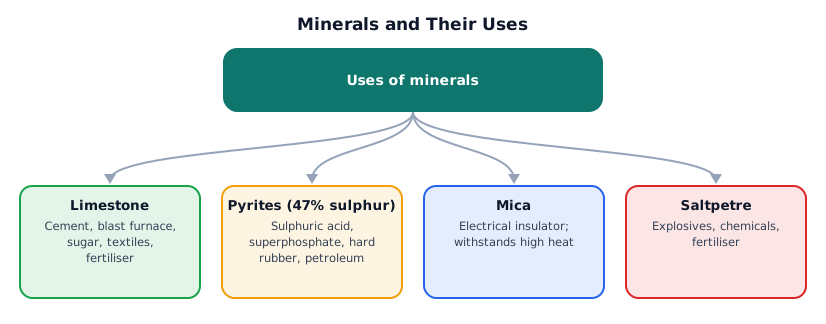
- Limestone is the main raw material of cement; it is also used in steel blast furnaces and in sugar, cotton-textile and fertiliser industries.
- India's highest-grade limestone is found on the Kaimur plateau spread over Rohtas and Kaimur. Producing areas: Chunaittan, Ramdihra, Baulia, Banjari etc.
- Tin is obtained from cassiterite and used in many alloys. It occurs at Deoraj and Kurkkhand in Gaya.
- Dolomite is a raw material for blast furnaces and refractories; it is found in Rohtas.
- The Kaimur plateau (Rohtas-Kaimur).
- Karmatia (Jamui) is known for gold.
- Tin comes from cassiterite.
- Deoraj and Kurkkhand in Gaya.
- Dolomite: Rohtas (Banjari).
- Limestone.
- Question: India's highest-grade limestone is found on which plateau? Answer: Kaimur.
- Question: Which is NOT a limestone-producing area of Rohtas? Answer: Karmatia.
- Question: Tin is obtained from which mineral? Answer: Cassiterite.
- Question: Where in Bihar is tin found? Answer: Deoraj and Kurkkhand (Gaya).
- Question: Dolomite in Bihar is found in which district? Answer: Rohtas.
- Question: What is the main raw material of cement? Answer: Limestone.
MCQs
Answer this question, then use Next.
Question 1: India's highest-grade limestone is found on which plateau?
Question 2: Which is NOT a limestone-producing area of Rohtas?
Question 3: Tin is obtained from which mineral?
Question 4: Where in Bihar is tin found?
Question 5: Dolomite in Bihar is found in which district?
Question 6: What is the main raw material of cement?
One-liners
Write your answer, then submit to see the correct answer.
India's highest-grade limestone is found on which plateau?
Kaimur.Which is NOT a limestone-producing area of Rohtas?
Karmatia.Tin is obtained from which mineral?
Cassiterite.Where in Bihar is tin found?
Deoraj and Kurkkhand (Gaya).Dolomite in Bihar is found in which district?
Rohtas.What is the main raw material of cement?
Limestone.Concept
Subtopic 3.2: Pyrites
- Pyrites are a source of sulphur, containing about 47% sulphur. They are used in superphosphate, hard rubber and petroleum industries.
- They occur mainly in the Upper Vindhyan group: the Amjhor hills, Kisisimakoh, Mankoh etc.
- At Amjhor (Rohtas) pyrites are found over about 109 sq km, with estimated reserves of about 40 crore tonnes.
- Amjhor also has an iron pyrites factory.
- About 47%.
- About 109 sq km.
- About 40 crore tonnes.
- Upper Vindhyan: Amjhor hills, Kisisimakoh, Mankoh.
- Superphosphate, hard rubber and petroleum.
- Question: What percentage of sulphur do pyrites contain? Answer: 47%.
- Question: Over how much area are pyrites found at Amjhor? Answer: 109 sq km.
- Question: What are the estimated pyrites reserves of Amjhor? Answer: 40 crore t.
- Question: Pyrites mainly occur in which rock group? Answer: Upper Vindhyan.
- Question: Pyrites are used in which industries? Answer: Superphosphate, hard rubber, petroleum.
MCQs
Answer this question, then use Next.
Question 1: What percentage of sulphur do pyrites contain?
Question 2: Over how much area are pyrites found at Amjhor?
Question 3: What are the estimated pyrites reserves of Amjhor?
Question 4: Pyrites mainly occur in which rock group?
Question 5: Pyrites are used in which industries?
One-liners
Write your answer, then submit to see the correct answer.
What percentage of sulphur do pyrites contain?
47%.Over how much area are pyrites found at Amjhor?
109 sq km.What are the estimated pyrites reserves of Amjhor?
40 crore t.Pyrites mainly occur in which rock group?
Upper Vindhyan.Pyrites are used in which industries?
Superphosphate, hard rubber, petroleum.Concept
Subtopic 3.3: Feldspar, Bauxite and Uranium
- Feldspar occurs mainly in pegmatite with quartz and is used in ceramic, glass and refractory industries.
- Feldspar is found in Munger; commercial mining has been possible only where railway facilities exist.
- Bauxite occurs with laterite; it is found at Banjari (Rohtas).
- Uranium is used as fuel to run important reactors; it is found in the Gaya region.
- Feldspar occurs in pegmatite.
- Commercial mining is possible only where railways exist.
- Bauxite with laterite.
- Uranium: Gaya.
- Question: Feldspar mainly occurs with quartz in which rock? Answer: Pegmatite.
- Question: Why is commercial feldspar mining limited to some areas of Munger? Answer: Only where rail facilities exist.
- Question: Bauxite occurs at Banjari (Rohtas) along with what? Answer: Laterite.
- Question: Uranium in Bihar is found in which region? Answer: Gaya.
MCQs
Answer this question, then use Next.
Question 1: Feldspar mainly occurs with quartz in which rock?
Question 2: Why is commercial feldspar mining limited to some areas of Munger?
Question 3: Bauxite occurs at Banjari (Rohtas) along with what?
Question 4: Uranium in Bihar is found in which region?
One-liners
Write your answer, then submit to see the correct answer.
Feldspar mainly occurs with quartz in which rock?
Pegmatite.Why is commercial feldspar mining limited to some areas of Munger?
Only where rail facilities exist.Bauxite occurs at Banjari (Rohtas) along with what?
Laterite.Uranium in Bihar is found in which region?
Gaya.Concept
Subtopic 3.4: Reh, Saltpetre and Sodium Salt
- Reh is an alkaline soil found near saltpetre areas in rural tracts; besides north-west Bihar, also in parts of Patna, Gaya and Munger.
- Bihar has produced saltpetre since ancient times; the East India Company began its export.
- It occurs as noniya soil; main areas are Saran, Begusarai, Samastipur, Siwan, Gopalganj, East Champaran and Muzaffarpur. It is used for explosives, chemicals and fertilisers.
- Sodium salt is plentiful in Saran, East Champaran, Muzaffarpur and West Champaran, and also occurs in Nawada, Gaya and Munger.
- Reh is an alkaline soil.
- The East India Company.
- As noniya soil.
- Rohtas is a limestone/pyrites district.
- Explosives, chemicals and fertiliser.
- Saran, E & W Champaran and Muzaffarpur.
- Question: What type of soil is reh? Answer: Alkaline.
- Question: Who began the export of saltpetre from Bihar? Answer: East India Company.
- Question: In what form is saltpetre found in rural areas? Answer: Noniya soil.
- Question: Which is NOT a main saltpetre-producing district? Answer: Rohtas.
- Question: Bihar's saltpetre is mainly used for making what? Answer: Explosives.
- Question: Sodium salt is most plentiful in which group of districts? Answer: Saran, E. Champaran, Muzaffarpur, W. Champaran.
MCQs
Answer this question, then use Next.
Question 1: What type of soil is reh?
Question 2: Who began the export of saltpetre from Bihar?
Question 3: In what form is saltpetre found in rural areas?
Question 4: Which is NOT a main saltpetre-producing district?
Question 5: Bihar's saltpetre is mainly used for making what?
Question 6: Sodium salt is most plentiful in which group of districts?
One-liners
Write your answer, then submit to see the correct answer.
What type of soil is reh?
Alkaline.Who began the export of saltpetre from Bihar?
East India Company.In what form is saltpetre found in rural areas?
Noniya soil.Which is NOT a main saltpetre-producing district?
Rohtas.Bihar's saltpetre is mainly used for making what?
Explosives.Sodium salt is most plentiful in which group of districts?
Saran, E. Champaran, Muzaffarpur, W. Champaran.Concept
Subtopic 3.5: Slate, Lead, Gold, Sandstone and Soapstone
- Current position (2026): the Sono area of Jamui has 222.88 million t of gold-bearing ore containing about 37.6 t of gold, about 44% of India's primary gold ore (National Mineral Inventory). It is a 'resource', not yet a proven reserve; trial production is targeted for 2027-28. Jamui also has magnetite (iron ore) in the Majos block (48.4 million t).
- Slate is found in the Kharagpur hills of Munger and Jamui.
- Lead is obtained from galena and is found at some places in Bhagalpur. Gold is found at Karmatia (Munger, now Jamui).
- Sandstone is used as decorative building stone and in glass; the Kaimur hills of Rohtas have large reserves of high-silica sandstone.
- Soapstone is used in cosmetics and paint; a large deposit exists at Shankarpur (Jamui).
- About 44%: 222.88 million t of ore in the Sono area.
- Sono, Jamui district (Karmatia is nearby).
- Karmatia (Munger district as printed; now Jamui).
- Shankarpur in Jamui.
- Cosmetics and paint.
- Kaimur hills of Rohtas.
- Kharagpur hills of Munger and Jamui.
- Lead (from galena) in Bhagalpur.
- Question: Bihar's share in India's primary gold ore resources (Jamui) is about: Answer: 44%.
- Question: India's largest gold ore resource is in which area of Bihar? Answer: Sono (Jamui).
- Question: Where is gold found in Bihar? Answer: Karmatia.
- Question: Where is a large soapstone deposit found? Answer: Shankarpur, Jamui.
- Question: Soapstone is mainly used in which industries? Answer: Cosmetics and paint.
- Question: High-silica sandstone reserves are found in which hills? Answer: Kaimur hills of Rohtas.
- Question: Slate is found in which hills? Answer: Kharagpur hills (Munger-Jamui).
- Question: Lead in Bihar is found in which district? Answer: Bhagalpur.
MCQs
Answer this question, then use Next.
Question 1: Bihar's share in India's primary gold ore resources (Jamui) is about:
Question 2: India's largest gold ore resource is in which area of Bihar?
Question 3: Where is gold found in Bihar?
Question 4: Where is a large soapstone deposit found?
Question 5: Soapstone is mainly used in which industries?
Question 6: High-silica sandstone reserves are found in which hills?
Question 7: Slate is found in which hills?
Question 8: Lead in Bihar is found in which district?
One-liners
Write your answer, then submit to see the correct answer.
Bihar's share in India's primary gold ore resources (Jamui) is about:
44%.India's largest gold ore resource is in which area of Bihar?
Sono (Jamui).Where is gold found in Bihar?
Karmatia.Where is a large soapstone deposit found?
Shankarpur, Jamui.Soapstone is mainly used in which industries?
Cosmetics and paint.High-silica sandstone reserves are found in which hills?
Kaimur hills of Rohtas.Slate is found in which hills?
Kharagpur hills (Munger-Jamui).Lead in Bihar is found in which district?
Bhagalpur.