Module 1: Infrastructure and the Power Sector
Concept
Subtopic 1.1: What Is Infrastructure?
- Current position (Bihar Economic Survey 2025-26): per-capita power consumption rose from 134 kWh (2011-12) to 374 kWh (2024-25). A record 8,752 MW was supplied in a day in 2025; towns get about 24 hours and villages about 22 hours of supply. AT&C losses fell from 42.99% (2013-14) to 15.54% (2024-25). The 2012-13 description is given below.
- Infrastructure in Bihar means basic facilities such as electricity, water (irrigation, drinking water), roads, bridges, schools, colleges and hospitals.
- Strong roads, irrigation and electricity are essential for the state's development.
- Electricity generation and distribution are in the Concurrent List of the Constitution.
- Before independence, power in Bihar came mainly from private thermal stations. A late electricity board and delayed plants raised project costs, and a gap between generation, distribution and demand persisted from the start.
- As per the Bihar Economic Survey 2012-13, demand grew about 8% a year over the past 6 years, but supply stayed inadequate, causing large shortages at peak demand.
- 374 kWh (134 kWh in 2011-12).
- 8,752 MW.
- Electricity is in the Concurrent List.
- About 8% a year.
- Private thermal stations.
- Power, water, roads, bridges, schools, colleges, hospitals.
- Question: Bihar's per-capita electricity consumption in 2024-25 was: Answer: 374 kWh.
- Question: Record one-day power supply in Bihar in 2025: Answer: 8,752 MW.
- Question: Electricity generation and distribution are placed in which list of the Constitution? Answer: Concurrent List.
- Question: At what annual rate did power demand grow in Bihar over 6 years (Economic Survey 2012-13)? Answer: About 8%.
- Question: Before independence, Bihar's power came mainly from where? Answer: Private thermal stations.
- Question: Which of these is part of 'infrastructure'? Answer: Electricity, water, roads, hospitals.
MCQs
Answer this question, then use Next.
Question 1: Bihar's per-capita electricity consumption in 2024-25 was:
Question 2: Record one-day power supply in Bihar in 2025:
Question 3: Electricity generation and distribution are placed in which list of the Constitution?
Question 4: At what annual rate did power demand grow in Bihar over 6 years (Economic Survey 2012-13)?
Question 5: Before independence, Bihar's power came mainly from where?
Question 6: Which of these is part of 'infrastructure'?
One-liners
Write your answer, then submit to see the correct answer.
Bihar's per-capita electricity consumption in 2024-25 was:
374 kWh.Record one-day power supply in Bihar in 2025:
8,752 MW.Electricity generation and distribution are placed in which list of the Constitution?
Concurrent List.At what annual rate did power demand grow in Bihar over 6 years (Economic Survey 2012-13)?
About 8%.Before independence, Bihar's power came mainly from where?
Private thermal stations.Which of these is part of 'infrastructure'?
Electricity, water, roads, hospitals.Concept
Subtopic 1.2: Energy Agencies and the BSEB
- Three main agencies work in Bihar's energy sector: BSEB (Bihar State Electricity Board), BSHPC (Bihar State Hydroelectric Power Corporation) and BREDA (Bihar Renewable Energy Development Agency).
- The BSEB was set up on 1 April 1958 under Section 5 of the Electricity (Supply) Act, 1948, mandated for generation, transmission and distribution in Bihar.
- Under the Bihar State Electricity Reforms Transfer Scheme, 2012, the board was split into five companies, effective 1 November 2012.
- The five: Bihar State Power (Holding) Co., Transmission Co., Generation Co., South Bihar Distribution Co. and North Bihar Distribution Co.
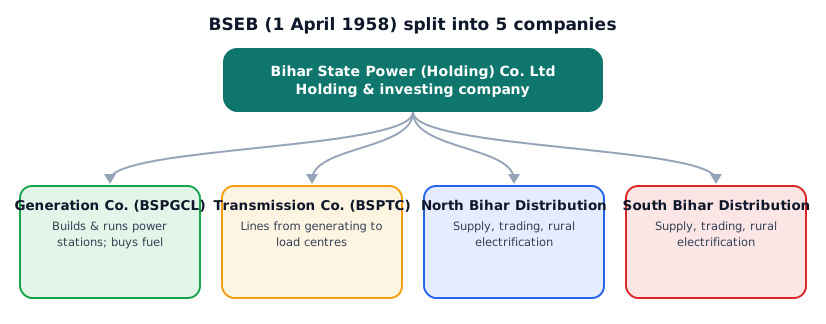
- 1 April 1958.
- Section 5 of the Electricity (Supply) Act, 1948.
- 1 November 2012.
- Five companies.
- The three are BSEB, BSHPC and BREDA.
- Question: When was the Bihar State Electricity Board set up? Answer: 1 April 1958.
- Question: Under which law was the BSEB set up? Answer: Electricity (Supply) Act 1948, Section 5.
- Question: From when did the split of the BSEB into five companies take effect? Answer: 1 November 2012.
- Question: Into how many companies was the BSEB divided? Answer: Five.
- Question: Which is NOT one of the three main energy agencies of Bihar? Answer: NTPC.
MCQs
Answer this question, then use Next.
Question 1: When was the Bihar State Electricity Board set up?
Question 2: Under which law was the BSEB set up?
Question 3: From when did the split of the BSEB into five companies take effect?
Question 4: Into how many companies was the BSEB divided?
Question 5: Which is NOT one of the three main energy agencies of Bihar?
One-liners
Write your answer, then submit to see the correct answer.
When was the Bihar State Electricity Board set up?
1 April 1958.Under which law was the BSEB set up?
Electricity (Supply) Act 1948, Section 5.From when did the split of the BSEB into five companies take effect?
1 November 2012.Into how many companies was the BSEB divided?
Five.Which is NOT one of the three main energy agencies of Bihar?
NTPC.Concept
Subtopic 1.3: Roles of the New Power Companies
- The holding company (printed as 'BSHPC'; actually Bihar State Power (Holding) Co. Ltd, BSPHCL) holds the other four companies. It owns the former BSEB's assets, is mainly an investing company, coordinates them and settles disputes.
- Generation Co. (BSPGCL) coordinates and advises on building, running and maintaining generating stations, and handles fuel purchase, its transport and pending disputes.
- Transmission Co. (BSPTC) owns the transmission assets; it plans and coordinates intra-state transmission and develops efficient lines from generating centres to load centres.
- North and South Bihar Distribution Companies distribute power to all consumers, trade power, run rural electrification schemes and open access as per the Electricity Act, 2003; they float tenders and sign power purchase agreements.
- Allocations for the BSEB in 2012-13 included the Restructured Accelerated Power Development and Reforms Programme (R-APDRP).
- Generation, transmission and two distribution companies.
- BSPGCL handles fuel.
- The transmission company.
- Electricity Act, 2003.
- Restructured Accelerated Power Development and Reforms Programme.
- The holding company.
- Question: How many companies does the holding company hold? Answer: Four.
- Question: Which company is responsible for fuel purchase and its transport? Answer: Generation company (BSPGCL).
- Question: Which company develops lines from generating centres to load centres? Answer: BSPTC (Transmission).
- Question: Distribution companies run open access as per which Act? Answer: Electricity Act 2003.
- Question: What does R-APDRP stand for? Answer: Restructured Accelerated Power Development and Reforms Programme.
- Question: Which company is mainly an investing company? Answer: Holding company.
MCQs
Answer this question, then use Next.
Question 1: How many companies does the holding company hold?
Question 2: Which company is responsible for fuel purchase and its transport?
Question 3: Which company develops lines from generating centres to load centres?
Question 4: Distribution companies run open access as per which Act?
Question 5: What does R-APDRP stand for?
Question 6: Which company is mainly an investing company?
One-liners
Write your answer, then submit to see the correct answer.
How many companies does the holding company hold?
Four.Which company is responsible for fuel purchase and its transport?
Generation company (BSPGCL).Which company develops lines from generating centres to load centres?
BSPTC (Transmission).Distribution companies run open access as per which Act?
Electricity Act 2003.What does R-APDRP stand for?
Restructured Accelerated Power Development and Reforms Programme.Which company is mainly an investing company?
Holding company.