Module 1: Organic Farming & Agricultural Regions
Concept
Subtopic 1.1: Vermicompost and Organic Villages
- The first vermicompost unit of Bihar was set up at Khodavandpur in Begusarai district on the initiative of Dr. R. K. Sohane.
- In 2006 the Bihar government launched the Vermicompost Promotion Scheme; Kothia in Samastipur district then became the state's first organic village.
- The number of organic villages in the state is 38 (source: Hindustan, Patna, 22 January 2011).
- The first vermicompost unit came up at Khodavandpur (Begusarai) on Dr. R. K. Sohane's initiative.
- Dr. R. K. Sohane took the initiative for the Khodavandpur vermicompost unit.
- Kothia in Samastipur district became the first organic village of the state.
- The state has 38 organic villages.
- Question: Where was Bihar's first vermicompost unit set up? Answer: Khodavandpur, Begusarai.
- Question: On whose initiative was the first vermicompost unit of Bihar established? Answer: Dr. R. K. Sohane.
- Question: Which village became Bihar's first organic village after the 2006 vermicompost scheme? Answer: Kothia (Samastipur).
- Question: How many organic villages does Bihar have (Hindustan, 22 Jan 2011)? Answer: 38.
MCQs
Answer this question, then use Next.
Question 1: Where was Bihar's first vermicompost unit set up?
Question 2: On whose initiative was the first vermicompost unit of Bihar established?
Question 3: Which village became Bihar's first organic village after the 2006 vermicompost scheme?
Question 4: How many organic villages does Bihar have (Hindustan, 22 Jan 2011)?
One-liners
Write your answer, then submit to see the correct answer.
Where was Bihar's first vermicompost unit set up?
Khodavandpur, Begusarai.On whose initiative was the first vermicompost unit of Bihar established?
Dr. R. K. Sohane.Which village became Bihar's first organic village after the 2006 vermicompost scheme?
Kothia (Samastipur).How many organic villages does Bihar have (Hindustan, 22 Jan 2011)?
38.Concept
Subtopic 1.2: Agricultural Regions of Bihar
- Bihar is divided into five agricultural regions on the basis of crops and geographical features.
- North-East Plain: rice and jute; flood plain with clay soil, good fertility and humidity, rainfall above 125 cm.
- North-West Plain: rice, sugarcane; rainfall below 125 cm but irrigation from the Gandak command and groundwater; old alluvium, soil holds more moisture and has a high lime content.
- North-Central Plain: rice, maize, wheat; the area between the Gandak and the Kosi; flood plain with light and clayey soils; canals and tube-wells allow rabi crops too.
- South-West Plain: rice, sugarcane, wheat; plains west of the Kharagpur hills and the irrigated Son command area.
- South-East Plain: rice, maize, wheat, sugarcane; rainfall above 125 cm, yet drought is frequent for lack of irrigation.
| Agricultural region | Main crops | Key feature |
|---|---|---|
| North-East Plain | Rice, jute | Flood plain, clay soil, rain > 125 cm |
| North-West Plain | Rice, sugarcane | Rain < 125 cm; Gandak command; limey soil |
| North-Central Plain | Rice, maize, wheat | Between Gandak and Kosi |
| South-West Plain | Rice, sugarcane, wheat | West of Kharagpur hills; Son command |
| South-East Plain | Rice, maize, wheat, sugarcane | Rain > 125 cm; drought for lack of irrigation |
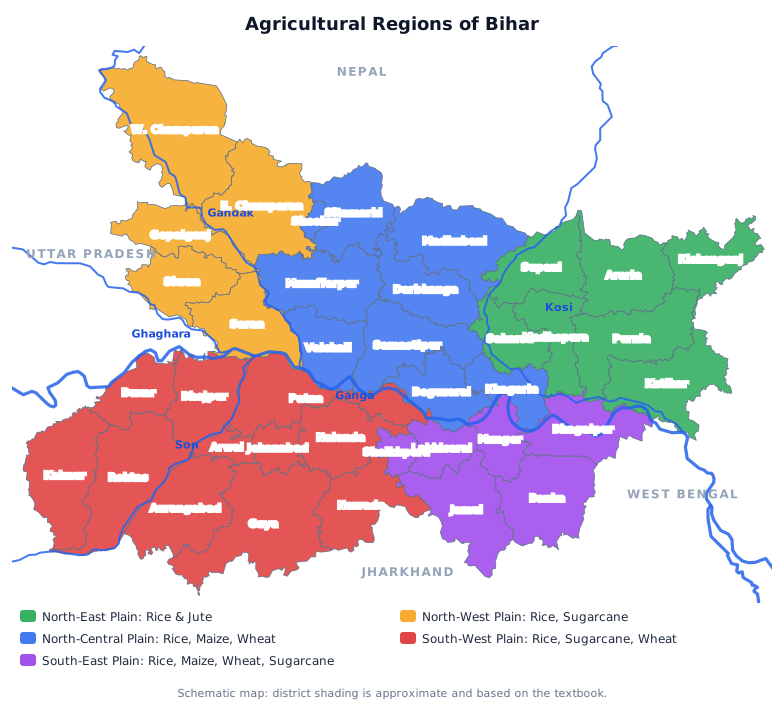
- The North-East Plain grows mainly rice and jute (flood plain, clay soil, rain above 125 cm).
- These are the features of the North-West Plain, which grows rice and sugarcane.
- The North-Central Plain is the area from the Gandak to the Kosi; it grows rice, maize and wheat.
- The South-West Plain lies west of the Kharagpur hills and includes the irrigated Son command area (rice, sugarcane, wheat).
- The South-East Plain (rice, maize, wheat, sugarcane) faces drought due to lack of irrigation.
- Question: Which pair of crops is dominant in the North-East Plain agricultural region? Answer: Rice and jute.
- Question: In which agricultural region is rainfall below 125 cm, but irrigation comes from the Gandak command and groundwater, and the soil has a high lime content? Answer: North-West Plain.
- Question: The North-Central Plain agricultural region lies between which two rivers? Answer: Gandak and Kosi.
- Question: The South-West Plain agricultural region lies west of which hills and includes which command area? Answer: Kharagpur hills; Son command.
- Question: Which agricultural region gets more than 125 cm of rain yet suffers frequent drought because irrigation is lacking? Answer: South-East Plain.
MCQs
Answer this question, then use Next.
Question 1: Which pair of crops is dominant in the North-East Plain agricultural region?
Question 2: In which agricultural region is rainfall below 125 cm, but irrigation comes from the Gandak command and groundwater, and the soil has a high lime content?
Question 3: The North-Central Plain agricultural region lies between which two rivers?
Question 4: The South-West Plain agricultural region lies west of which hills and includes which command area?
Question 5: Which agricultural region gets more than 125 cm of rain yet suffers frequent drought because irrigation is lacking?
One-liners
Write your answer, then submit to see the correct answer.
Which pair of crops is dominant in the North-East Plain agricultural region?
Rice and jute.In which agricultural region is rainfall below 125 cm, but irrigation comes from the Gandak command and groundwater, and the soil has a high lime content?
North-West Plain.The North-Central Plain agricultural region lies between which two rivers?
Gandak and Kosi.The South-West Plain agricultural region lies west of which hills and includes which command area?
Kharagpur hills; Son command.Which agricultural region gets more than 125 cm of rain yet suffers frequent drought because irrigation is lacking?
South-East Plain.