Module 2: Pulses (II): Khesari, Moong, Masoor and Others
Concept
Subtopic 2.1: Khesari
- Khesari (khandsari) is a low-grade pulse, yet it is sown on the largest area among pulses in Bihar.
- The poor eat it as dal while the well-off use it as cattle fodder. It is grown mainly in Patna, Gaya and Shahabad.
- Eating khesari dal harms health, causing arthritis and other bone diseases; hence the government has banned its consumption.
- Khesari, a low-grade pulse, covers the largest area among pulses.
- Khesari consumption causes arthritis and other bone diseases.
- Khesari is grown mainly in Patna, Gaya and Shahabad.
- Question: Which pulse is sown on the largest area among pulses in Bihar? Answer: Khesari.
- Question: Why has the government banned the consumption of khesari dal? Answer: It causes arthritis and bone diseases.
- Question: Khesari is grown mainly in which districts? Answer: Patna, Gaya, Shahabad.
MCQs
Answer this question, then use Next.
Question 1: Which pulse is sown on the largest area among pulses in Bihar?
Question 2: Why has the government banned the consumption of khesari dal?
Question 3: Khesari is grown mainly in which districts?
One-liners
Write your answer, then submit to see the correct answer.
Which pulse is sown on the largest area among pulses in Bihar?
Khesari.Why has the government banned the consumption of khesari dal?
It causes arthritis and bone diseases.Khesari is grown mainly in which districts?
Patna, Gaya, Shahabad.Concept
Subtopic 2.2: Moong
- Moong is sown after the wheat harvest and is ready before paddy sowing; it is grown mainly in the plains.
- Main districts: Munger, Sheikhpura, Bhagalpur, Saharsa, Supaul and Purnia.
- Moong fits between the wheat harvest and paddy sowing.
- Munger, Sheikhpura, Bhagalpur, Saharsa, Supaul and Purnia are the main moong districts.
- Question: Which pulse is sown after the wheat harvest and is ready before paddy sowing? Answer: Moong.
- Question: Which group lists the main moong-producing districts? Answer: Munger, Sheikhpura, Bhagalpur, Saharsa, Supaul, Purnia.
MCQs
Answer this question, then use Next.
Question 1: Which pulse is sown after the wheat harvest and is ready before paddy sowing?
Question 2: Which group lists the main moong-producing districts?
One-liners
Write your answer, then submit to see the correct answer.
Which pulse is sown after the wheat harvest and is ready before paddy sowing?
Moong.Which group lists the main moong-producing districts?
Munger, Sheikhpura, Bhagalpur, Saharsa, Supaul, Purnia.Concept
Subtopic 2.3: Masoor, Urad and Kulthi
- Masoor holds a leading place among pulses; Patna district produces the most masoor. It is a rabi crop.
- Main masoor districts: Nalanda, Patna, Gaya, Jehanabad, Munger and Aurangabad.
- Among other pulses, urad and kulthi are important; both are bhadai crops, grown in Bhagalpur and Katihar.
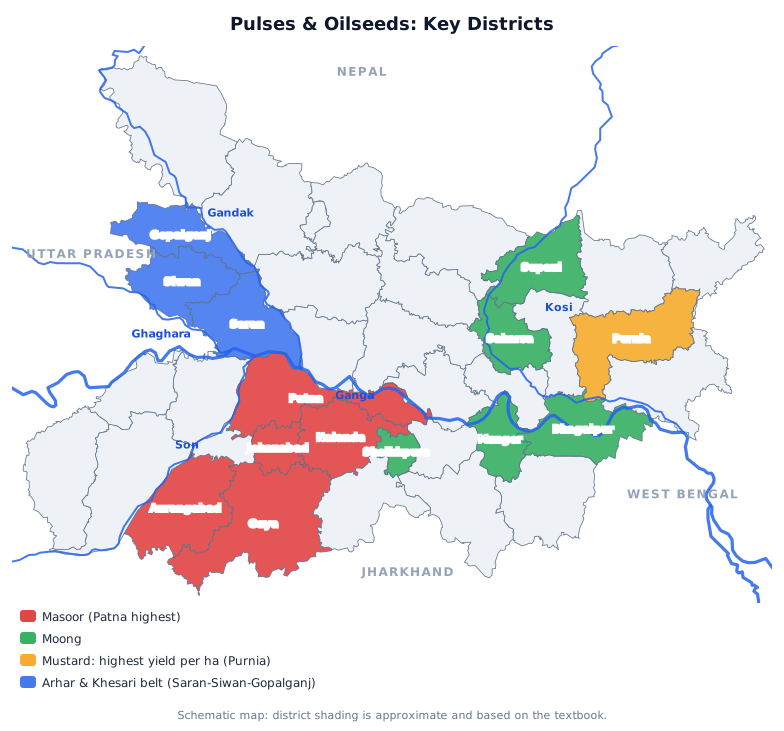
- Patna district produces the most masoor; it is a rabi crop.
- Urad and kulthi are both bhadai crops.
- Urad and kulthi are grown in Bhagalpur and Katihar.
- Question: Which district produces the most masoor in Bihar? Answer: Patna.
- Question: Urad and kulthi are crops of which season? Answer: Bhadai.
- Question: Urad and kulthi are grown in which districts? Answer: Bhagalpur and Katihar.
MCQs
Answer this question, then use Next.
Question 1: Which district produces the most masoor in Bihar?
Question 2: Urad and kulthi are crops of which season?
Question 3: Urad and kulthi are grown in which districts?
One-liners
Write your answer, then submit to see the correct answer.
Which district produces the most masoor in Bihar?
Patna.Urad and kulthi are crops of which season?
Bhadai.Urad and kulthi are grown in which districts?
Bhagalpur and Katihar.