Module 4: Cash Crops: Sugarcane, Jute and Tobacco
Concept
Subtopic 4.1: Sugarcane
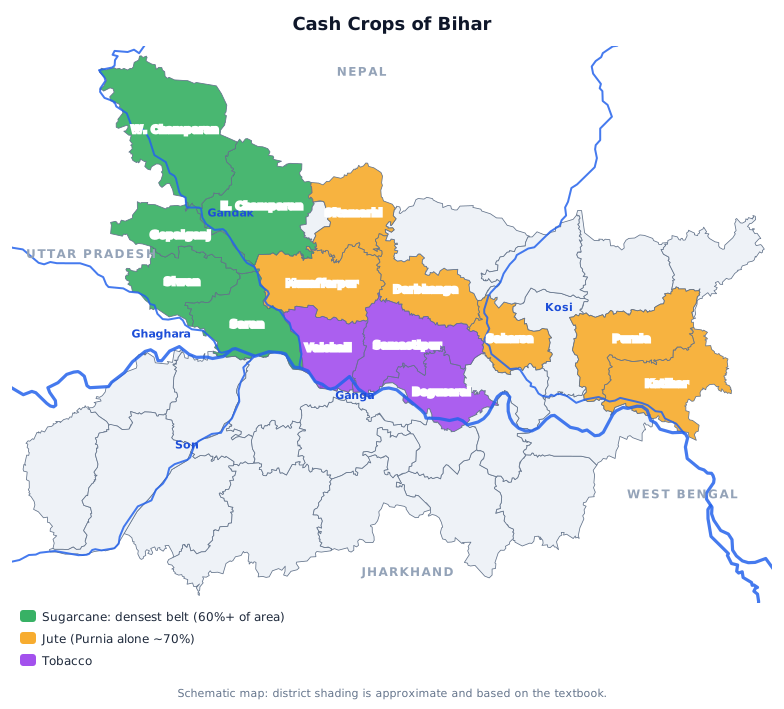
- Current position (e-Statistics 2024-25): sugarcane production about 121.5 lakh t, with West Champaran, East Champaran, Gopalganj and Samastipur as the cane belt.
- Bihar is one of India's major sugarcane states; sugarcane is a cash crop used mostly by the sugar industry.
- It needs heavy rainfall, friable loam (clayey and limey soil) and a temperature of about 26°C.
- Soils west of the Bagmati and Kosi contain lime and mineral salts.
- The densest sugarcane belt, with over 60% of the cane area, is confined to East and West Champaran, Gopalganj, Saran and Siwan.
- General cultivation: west of the Kosi, and south of the Ganga in Bhojpur, Aurangabad, Patna, Nalanda, Munger and Bhagalpur.
- About 1.3 lakh hectares (about 4.41% of the cropped area) is under sugarcane.
- About 121.5 lakh tonnes.
- Sugarcane needs heavy rain, friable loam (clayey and limey soil) and about 26°C.
- Over 60% of the cane area is in East and West Champaran, Gopalganj, Saran and Siwan.
- About 1.3 lakh ha, roughly 4.41% of the cropped area.
- Soils west of the Bagmati and Kosi contain lime.
- Question: Bihar's sugarcane production in 2024-25 was about: Answer: 121 lakh t.
- Question: What temperature does sugarcane need? Answer: 26°C.
- Question: The densest sugarcane belt (over 60% of the cane area) lies in which districts? Answer: E & W Champaran, Gopalganj, Saran, Siwan.
- Question: About how much land in Bihar is under sugarcane? Answer: 1.3 lakh ha.
- Question: Lime-rich soils with mineral salts lie west of which rivers? Answer: Bagmati and Kosi.
MCQs
Answer this question, then use Next.
Question 1: Bihar's sugarcane production in 2024-25 was about:
Question 2: What temperature does sugarcane need?
Question 3: The densest sugarcane belt (over 60% of the cane area) lies in which districts?
Question 4: About how much land in Bihar is under sugarcane?
Question 5: Lime-rich soils with mineral salts lie west of which rivers?
One-liners
Write your answer, then submit to see the correct answer.
Bihar's sugarcane production in 2024-25 was about:
121 lakh t.What temperature does sugarcane need?
26°C.The densest sugarcane belt (over 60% of the cane area) lies in which districts?
E & W Champaran, Gopalganj, Saran, Siwan.About how much land in Bihar is under sugarcane?
1.3 lakh ha.Lime-rich soils with mineral salts lie west of which rivers?
Bagmati and Kosi.Concept
Subtopic 4.2: Jute
- Jute is used for coarse cloth, tat (gunny), sacks, ropes and carpets.
- Bihar is the second largest jute state of India, with enough rain and fertile alluvial (kanp) soil brought by rivers.
- Purnia grows the most jute, followed by Katihar, Saharsa, Champaran, Darbhanga, Sitamarhi and Muzaffarpur.
- Purnia alone produces about 70% of Bihar's jute.
- Jute is sown in April-May after the first heavy summer rain and harvested in October; plants grow up to 10 feet.
- Bihar is the second largest jute-producing state of India.
- Purnia alone produces about 70% of the state's jute.
- Jute is sown in April-May after the first heavy summer rain and harvested in October.
- Jute plants grow up to 10 feet.
- Question: What is Bihar's rank in India in jute production? Answer: Second.
- Question: Which district alone produces about 70% of Bihar's jute? Answer: Purnia.
- Question: When is jute sown and harvested in Bihar? Answer: Sown Apr-May, harvested Oct.
- Question: Up to what height can jute plants grow under favourable conditions? Answer: 10 feet.
MCQs
Answer this question, then use Next.
Question 1: What is Bihar's rank in India in jute production?
Question 2: Which district alone produces about 70% of Bihar's jute?
Question 3: When is jute sown and harvested in Bihar?
Question 4: Up to what height can jute plants grow under favourable conditions?
One-liners
Write your answer, then submit to see the correct answer.
What is Bihar's rank in India in jute production?
Second.Which district alone produces about 70% of Bihar's jute?
Purnia.When is jute sown and harvested in Bihar?
Sown Apr-May, harvested Oct.Up to what height can jute plants grow under favourable conditions?
10 feet.Concept
Subtopic 4.3: Tobacco
- Bihar is the sixth largest tobacco-producing state of India.
- In 1508 a Portuguese traveller brought the tobacco plant from North America to Europe and then to India.
- Tobacco is grown on about 14 thousand hectares, producing about 17 thousand tonnes, along river banks from the Gandak to Bihar's eastern border.
- Main districts: Vaishali, Samastipur, Begusarai, Purnia and Gopalganj.
- Bihar is the sixth largest tobacco-producing state.
- In 1508 a Portuguese traveller brought tobacco from North America to Europe and then to India.
- About 14 thousand ha yield about 17 thousand tonnes of tobacco.
- Vaishali, Samastipur, Begusarai, Purnia and Gopalganj are the main tobacco districts.
- Question: What is Bihar's rank in India in tobacco production? Answer: Sixth.
- Question: In which year did a Portuguese traveller bring tobacco to India (via Europe)? Answer: 1508.
- Question: About how much tobacco is produced in Bihar, and on how much land? Answer: 14 thousand ha; 17 thousand t.
- Question: Which group lists the main tobacco districts? Answer: Vaishali, Samastipur, Begusarai, Purnia, Gopalganj.
MCQs
Answer this question, then use Next.
Question 1: What is Bihar's rank in India in tobacco production?
Question 2: In which year did a Portuguese traveller bring tobacco to India (via Europe)?
Question 3: About how much tobacco is produced in Bihar, and on how much land?
Question 4: Which group lists the main tobacco districts?
One-liners
Write your answer, then submit to see the correct answer.
What is Bihar's rank in India in tobacco production?
Sixth.In which year did a Portuguese traveller bring tobacco to India (via Europe)?
1508.About how much tobacco is produced in Bihar, and on how much land?
14 thousand ha; 17 thousand t.Which group lists the main tobacco districts?
Vaishali, Samastipur, Begusarai, Purnia, Gopalganj.