Module 1: Rise of Tribal Kingdoms in Bihar: Chero, Kharwar & Bhar Dynasties
Concept
Subtopic 1.1: Post-Pala Political Vacuum & Emergence of Tribal Principalities in Bihar
Following the decline of the imperial Pala Dynasty in the 12th century, central and western Bihar witnessed the rise of powerful indigenous tribal monarchies:
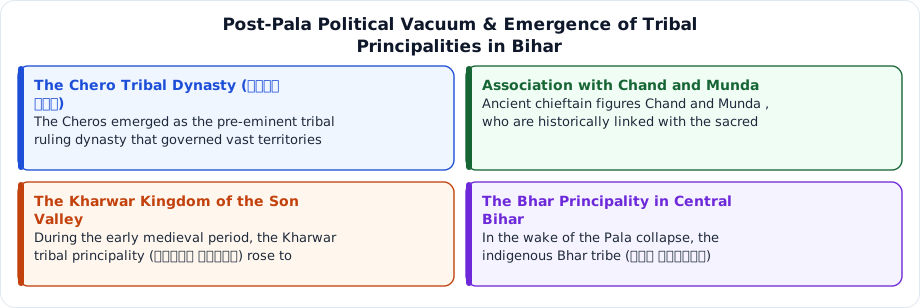
- The Chero Tribal Dynasty (चेरो वंश): The Cheros emerged as the pre-eminent tribal ruling dynasty that governed vast territories of Bihar. In the 12th century, the Cheros established an organized state extending across western Bihar, Shahabad (Bhojpur/Rohtas), Saran, Champaran, and Muzaffarpur.
- Association with Chand and Munda: Ancient chieftain figures Chand and Munda, who are historically linked with the sacred Mundeshwari and Chandeshwari temples in the Kaimur hills (Shahabad region), are traditionally associated with the Cheros of Shahabad.
- The Kharwar Kingdom of the Son Valley: During the early medieval period, the Kharwar tribal principality (खरवार राज्य) rose to prominent political authority in the fertile river valley of the Son River (modern Rohtas and Palamu belt). Rulers like Pratapadhavala of Japila left several stone inscriptions detailing their sovereignty.
- The Bhar Principality in Central Bihar: In the wake of the Pala collapse, the indigenous Bhar tribe (भार जनजाति) consolidated their authority and formed independent chieftainships across central Bihar.
- The Chero dynasty was the prominent tribal dynasty that ruled extensive parts of Bihar.
- In the 12th century, the Chero kingdom was organized in western Bihar, Champaran, and Muzaffarpur.
- Chand and Munda, associated with the Mundeshwari temple, were linked to the Cheros of Shahabad.
- The Kharwar tribal kingdom arose in the Son river valley during the early medieval era.
- The Bhar tribe established an independent principality in central Bihar following the Pala decline.
- Question: Which tribal dynasty ruled Bihar after the fall of the Palas? Answer: Chero Dynasty.
- Question: With whom are Chand and Munda of the Mundeshwari temple associated? Answer: Cheros of Shahabad.
- Question: Which tribal kingdom arose in the Son river valley? Answer: Kharwar kingdom.
- Question: Which tribe formed a state in central Bihar after the Palas? Answer: Bhar tribe.
- Question: In which century was the Chero state organized in western Bihar, Champaran, and Muzaffarpur? Answer: 12th century CE.
MCQs
Answer this question, then use Next.
Question 1: Which tribal dynasty ruled extensive regions of Bihar following the decline of the Pala Dynasty?
Question 2: In the 12th century, which tribal state was organized in western Bihar, Champaran, and Muzaffarpur?
Question 3: Chand and Munda, who are linked with the Chandeshwari and Mundeshwari temples, are associated with:
Question 4: In the early medieval period, which tribal state arose in the valley of the Son River?
Question 5: During the decline of the Palas, which tribal group organized its independent state in central Bihar?
Question 6: In which district of Bihar is the ancient Mundeshwari Temple situated?
Question 7: The famous ruler Pratapadhavala, whose inscriptions are found in Rohtas, belonged to which tribal lineage?
Question 8: In which division of ancient and medieval Bihar did the Cheros establish their earliest dense settlements?
Question 9: What architectural feature characterized the indigenous defensive settlements of the Cheros?
Question 10: Which language family did the indigenous tribal groups of Chero and Kharwar historically belong to?
One-liners
Write your answer, then submit to see the correct answer.
Which tribal dynasty ruled Bihar after the fall of the Palas?
Chero Dynasty.With whom are Chand and Munda of the Mundeshwari temple associated?
Cheros of Shahabad.Which tribal kingdom arose in the Son river valley?
Kharwar kingdom.Which tribe formed a state in central Bihar after the Palas?
Bhar tribe.In which century was the Chero state organized in western Bihar, Champaran, and Muzaffarpur?
12th century CE.