Module 1: Early Reorganization, Land Reform and Infrastructure
Concept
Subtopic 1.1: Land reform, the First Amendment, and the Kosi works
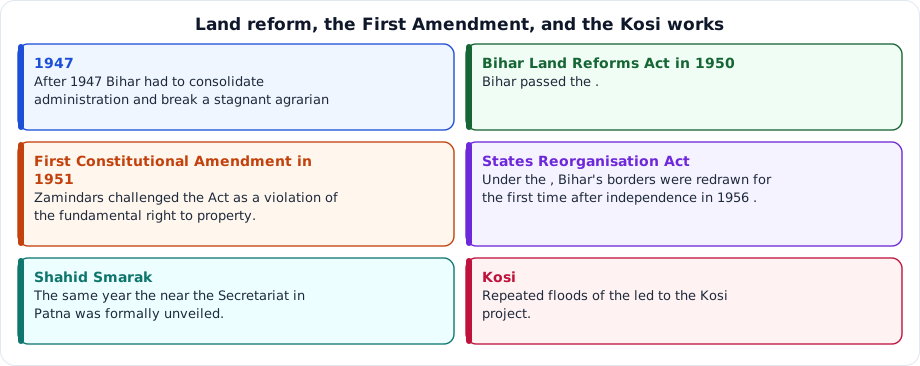
- After 1947 Bihar had to consolidate administration and break a stagnant agrarian order. The colonial zamindari system had left land and rural wealth with intermediaries, while tenant cultivators stayed poor.
- Bihar passed the Bihar Land Reforms Act in 1950. It was the first state in independent India to frame comprehensive land-reform legislation, and the first to enact a statutory zamindari abolition law.
- Zamindars challenged the Act as a violation of the fundamental right to property. In response the Centre passed the First Constitutional Amendment in 1951, adding Article 31B and the Ninth Schedule so that agrarian-reform laws could not be struck down on fundamental-rights grounds. Bihar was the direct reason for the first amendment of the Constitution.
- Under the States Reorganisation Act, Bihar's borders were redrawn for the first time after independence in 1956. Parts of Manbhum and Purnia went to West Bengal.
- The same year the Shahid Smarak near the Secretariat in Patna was formally unveiled. It commemorates seven students killed in the 1942 Quit India Movement.
- Repeated floods of the Kosi led to the Kosi project. During construction of the Kosi embankment in 1954, voluntary labour was mobilised for the first time as shramdaan. That effort also led to the Bharat Sevak Samaj, meant to draw the public into nation-building.
- The territorial reorganization of Bihar took place in 1956 under the States Reorganisation Act. Parts of Manbhum and Purnia were transferred to West Bengal.
- Bihar enacted the Bihar Land Reforms Act in 1950 and became the first state to pass comprehensive land-reform legislation.
- Bihar was the first state in independent India to enact a statutory law abolishing the zamindari system.
- When landlords challenged the Bihar Land Reforms Act, the First Constitutional Amendment of 1951 added Article 31B and the Ninth Schedule to protect land-reform laws.
- Construction of the Kosi embankment in 1954 used widespread voluntary labour, shramdaan, and led to the Bharat Sevak Samaj.
- The Shahid Smarak near the Secretariat in Patna, in memory of seven students killed in the 1942 Quit India Movement, was formally unveiled in 1956.
- Question: When were the borders of Bihar state reorganized for the first time after independence? Answer: 1956.
- Question: Which was the first state in India to enact land reform legislation? Answer: Bihar.
- Question: In which state of the country was the zamindari abolition law enacted first? Answer: Bihar.
- Question: The first amendment to the Constitution of India took place due to which state? Answer: Bihar.
- Question: For which river embankment in Bihar was shramdaan used for the first time, leading to the formation of the Bharat Sevak Samaj? Answer: Kosi dam.
- Question: When was the formal unveiling of the Shahid Smarak in Patna held? Answer: 1956.
MCQs
Answer this question, then use Next.
Question 27: When were the borders of Bihar state reorganized for the first time after independence?
Question 28: Which was the first state in India to enact land reform legislation?
Question 29: In which state of the country was the zamindari abolition law enacted first?
Question 30: The first amendment to the Constitution of India took place due to which state?
Question 33: For which river embankment in Bihar was shramdaan used for the first time, leading to the formation of the Bharat Sevak Samaj?
Question 36: When was the formal unveiling of the Shahid Smarak in Patna held?
One-liners
Write your answer, then submit to see the correct answer.
When were the borders of Bihar state reorganized for the first time after independence?
1956.Which was the first state in India to enact land reform legislation?
Bihar.In which state of the country was the zamindari abolition law enacted first?
Bihar.The first amendment to the Constitution of India took place due to which state?
Bihar.For which river embankment in Bihar was shramdaan used for the first time, leading to the formation of the Bharat Sevak Samaj?
Kosi dam.When was the formal unveiling of the Shahid Smarak in Patna held?
1956.