Module 5: British Suppression, Ambala Trials, Decline & Clemency (1852-1884)
Concept
Subtopic 5.1: The Judicial Dismantling of the Sadiqpur Bastion
Alarmed by the unceasing flow of arms, funds, and men from Patna to the frontiers, the British launched massive military and judicial onslaughts:
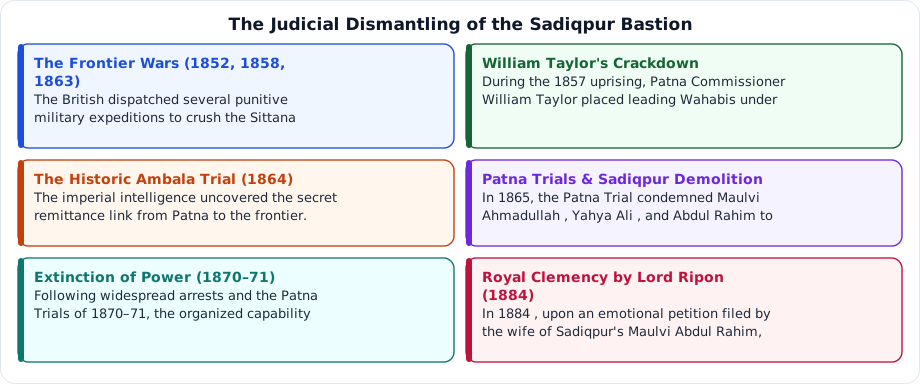
- The Frontier Wars (1852, 1858, 1863): The British dispatched several punitive military expeditions to crush the Sittana stronghold, decisively defeating the Wahabis in the frontier campaigns of 1852, 1858, and the bloody Ambela War of 1863.
- William Taylor's Crackdown: During the 1857 uprising, Patna Commissioner William Taylor placed leading Wahabis under house arrest and preemptive confinement.
- The Historic Ambala Trial (1864): The imperial intelligence uncovered the secret remittance link from Patna to the frontier. In the famous Ambala Trial of 1864, the Patna Wahabis were defended by prominent British barrister Mr. Plyden (प्लाइडेन). Three leaders were awarded capital punishment and eight were sentenced to transportation for life (Kalapani), though death sentences were ultimately commuted to life imprisonment.
- Patna Trials & Sadiqpur Demolition: In 1865, the Patna Trial condemned Maulvi Ahmadullah, Yahya Ali, and Abdul Rahim to imprisonment for life in the Cellular Jail of the Andaman Islands (Kalapani). The Patna sessions court originally sentenced Ahmadullah to death, but the High Court commuted it to life deportation. The British completely razed the Sadiqpur residences and family graves to dust.
- Extinction of Power (1870–71): Following widespread arrests and the Patna Trials of 1870–71, the organized capability and threat of the Patna Wahabis was completely extinguished by 1870–71.
- Royal Clemency by Lord Ripon (1884): In 1884, upon an emotional petition filed by the wife of Sadiqpur's Maulvi Abdul Rahim, Governor-General Lord Ripon ordered the release and pardon of the surviving Wahabi prisoners from the Andamans.
- William Taylor was the Commissioner of Patna during the Wahabi suppression.
- The British defeated the Wahabis in the wars of 1852, 1858, and 1863.
- In the 1864 Ambala Trial, lawyer Plyden defended the Patna Wahabis.
- Wahabi leaders Abdul Rahim, Yahya Ali, and Ahmadullah received life imprisonment and exile to the Andamans (Kalapani).
- Patna sessions court sentenced Ahmadullah to death, but the High Court commuted it to life exile.
- The organizational power of the Patna Wahabis completely ended by 1870-71.
- Governor-General Lord Ripon released the surviving Wahabi prisoners in 1884.
- Question: Who was the Commissioner of Patna during the Wahabi movement? Answer: William Taylor.
- Question: In which wars did the British defeat the Wahabis? Answer: Wars of 1852, 1858, and 1863.
- Question: Who was the defense lawyer for the Patna Wahabis in the 1864 Ambala trial? Answer: Plyden.
- Question: Which Wahabi leaders received life imprisonment and Kalapani? Answer: Abdul Rahim, Yahya Ali, and Ahmadullah.
- Question: By which years was the power of the Patna Wahabis extinguished? Answer: By 1870-71.
- Question: Which Governor-General released the remaining Wahabi prisoners in 1884? Answer: Lord Ripon.
MCQs
Answer this question, then use Next.
Question 1: Who was the Commissioner of Patna at the time of the Wahabi Movement?
Question 2: In which of the following wars did the British defeat the Wahabis?
Question 3: Who among the following Wahabi leaders was sentenced to life imprisonment and deportation to the Andamans (Kalapani)?
Question 4: Who among the following Wahabi leaders of Bihar was sentenced to life imprisonment (commuted from death penalty)?
Question 5: Who served as the defense advocate for the Wahabis of Patna during the famous 1864 Ambala Trial?
Question 6: By which period was the organizational power of the Patna Wahabis completely extinguished?
Question 7: Which Governor-General ordered the release and pardon of the remaining Wahabi prisoners in 1884?
One-liners
Write your answer, then submit to see the correct answer.
Who was the Commissioner of Patna during the Wahabi movement?
William Taylor.In which wars did the British defeat the Wahabis?
Wars of 1852, 1858, and 1863.Who was the defense lawyer for the Patna Wahabis in the 1864 Ambala trial?
Plyden.Which Wahabi leaders received life imprisonment and Kalapani?
Abdul Rahim, Yahya Ali, and Ahmadullah.By which years was the power of the Patna Wahabis extinguished?
By 1870-71.Which Governor-General released the remaining Wahabi prisoners in 1884?
Lord Ripon.