Module 4: Powers and Jurisdiction
Concept
Subtopic 4.1: Powers and Jurisdiction
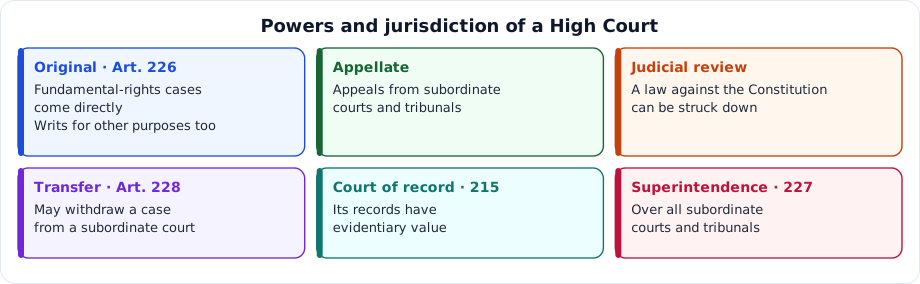
- The High Court's powers under Article 225 (existing jurisdiction):
- Original: under Article 226 any matter of fundamental rights can be brought directly to the High Court; it can issue writs for fundamental rights and other purposes.
- Appellate: hears appeals against decisions of subordinate courts and tribunals.
- Judicial review: can declare any law of Parliament or a state legislature that violates the Constitution unconstitutional.
- Transfer (Article 228): can withdraw a case from a subordinate court and decide or interpret it.
- Court of record (Article 215) and superintendence (Article 227) over all subordinate courts and tribunals.
- Article 226 (Supreme Court: Article 32).
- Article 215 (Supreme Court: Article 129).
- Article 227.
- Article 228.
- The High Court (Art 227).
- Judicial review.
- All three describe its jurisdiction.
- Question: Under which Article can a High Court issue writs? Answer: Article 226.
- Question: Which Article calls the High Court a court of record? Answer: Article 215.
- Question: Under which Article does a High Court superintend all subordinate courts and tribunals? Answer: Article 227.
- Question: Under which Article can a High Court withdraw a case from a subordinate court? Answer: Article 228.
- Question: [BPSC 40th] Who superintends the subordinate courts? Answer: High Court.
- Question: The power to declare a law unconstitutional is called: Answer: Judicial review.
- Question: [Objective set] Which statement about the state High Court is correct? Answer: All of the above.
MCQs
Answer this question, then use Next.
Question 1: Under which Article can a High Court issue writs?
Question 2: Which Article calls the High Court a court of record?
Question 3: Under which Article does a High Court superintend all subordinate courts and tribunals?
Question 4: Under which Article can a High Court withdraw a case from a subordinate court?
Question 5: [BPSC 40th] Who superintends the subordinate courts?
Question 6: The power to declare a law unconstitutional is called:
Question 7: [Objective set] Which statement about the state High Court is correct?
One-liners
Write your answer, then submit to see the correct answer.
Under which Article can a High Court issue writs?
Article 226.Which Article calls the High Court a court of record?
Article 215.Under which Article does a High Court superintend all subordinate courts and tribunals?
Article 227.Under which Article can a High Court withdraw a case from a subordinate court?
Article 228.[BPSC 40th] Who superintends the subordinate courts?
High Court.The power to declare a law unconstitutional is called:
Judicial review.[Objective set] Which statement about the state High Court is correct?
All of the above.