Module 3: Subordinate Courts
Concept
Subtopic 3.1: Subordinate Courts
- Article 233 deals with subordinate courts (district judges). Every district has a district court, kept independent of the executive.
- District judges are appointed by the Governor in consultation with the High Court. Other judges are selected through the Higher Judicial Service (by the HC) or the Provincial Judicial Service exam (by the State PSC).
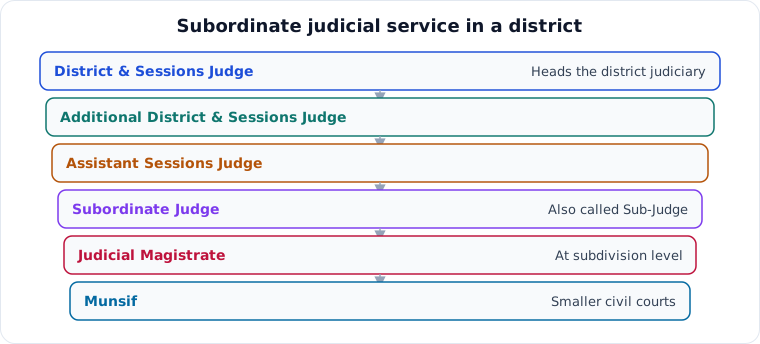
- A district has the District & Sessions Judge, assisted by Additional District Judges and Sub-Judges; subdivisions have Munsif or Judicial Magistrates. Officers of small courts are appointed by the state government.
- Order: District & Sessions Judge -> Additional District & Sessions Judge -> Assistant Sessions Judge -> Subordinate Judge -> Judicial Magistrate -> Munsif.
- Three kinds of courts in each district: (1) Civil (Diwani) - immovable property; (2) Criminal (Faujdari) - fights, assault; (3) Revenue - land revenue and rent (lagaan).

- Article 233.
- The Governor, in consultation with the HC.
- The civil (Diwani) court.
- The criminal court.
- The revenue court.
- Munsif is at the bottom of the chart.
- Munsif / Judicial Magistrate.
- Conducted by the State PSC.
- Question: Which Article deals with subordinate courts (appointment of district judges)? Answer: Article 233.
- Question: District judges are appointed by: Answer: Governor in consultation with the High Court.
- Question: Which court hears cases related to immovable property at district level? Answer: Civil (Diwani) court.
- Question: Cases of fights and assault are heard by the: Answer: Criminal (Faujdari) court.
- Question: Land revenue and rent (lagaan) cases go to the: Answer: Revenue court.
- Question: Which is the lowest rank in the subordinate judicial structure of a district? Answer: Munsif.
- Question: Which officers are found in the courts of subdivisions? Answer: Munsif or Judicial Magistrate.
- Question: Through which exam are judges of the provincial judicial service selected? Answer: State PSC's Provincial Judicial Service exam.
MCQs
Answer this question, then use Next.
Question 1: Which Article deals with subordinate courts (appointment of district judges)?
Question 2: District judges are appointed by:
Question 3: Which court hears cases related to immovable property at district level?
Question 4: Cases of fights and assault are heard by the:
Question 5: Land revenue and rent (lagaan) cases go to the:
Question 6: Which is the lowest rank in the subordinate judicial structure of a district?
Question 7: Which officers are found in the courts of subdivisions?
Question 8: Through which exam are judges of the provincial judicial service selected?
One-liners
Write your answer, then submit to see the correct answer.
Which Article deals with subordinate courts (appointment of district judges)?
Article 233.District judges are appointed by:
Governor in consultation with the High Court.Which court hears cases related to immovable property at district level?
Civil (Diwani) court.Cases of fights and assault are heard by the:
Criminal (Faujdari) court.Land revenue and rent (lagaan) cases go to the:
Revenue court.Which is the lowest rank in the subordinate judicial structure of a district?
Munsif.Which officers are found in the courts of subdivisions?
Munsif or Judicial Magistrate.Through which exam are judges of the provincial judicial service selected?
State PSC's Provincial Judicial Service exam.